

Showing posts with label erie county cemetries. Show all posts
Showing posts with label erie county cemetries. Show all posts
Monday, April 8, 2013

Tuesday, March 26, 2013
ship stone

Saturday, September 8, 2012
Forethought
 This fellow had this stone placed while alive, not knowing the century he would die in. If he is still alive, he has passed the century mark. He only wanted else known of his military service.[Riverside]
 Fred bought the stone after his wife died. They both belonged to masonic organisations. He is dead now, and he expected to die after 1927, but before 2000. No one has cut the two digits. No family survived him? Apparently no provision was made for the inscription update.[Maple Grove]
Saturday, November 26, 2011
Marry Mason
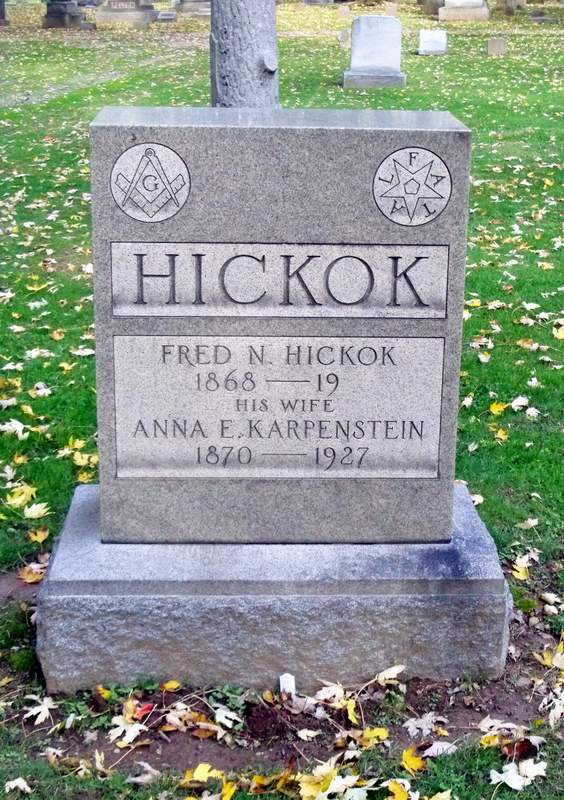
Fred *1868, ? †. Anna*1870, 1927†.
Seemingly, Fred outlived his spouse. Fred is not 143 years old. One could check records.It is possible, he left the area and is buried elsewhere. It is possible he had no one to take care of the detail to mark the date. Such occurrences are not rare. Was this one?
We see they were a masonic couple. On Fred's side is the common masonic symbol. The star pentagon on Anna's side is the emblem of the Order of the Eastern Star, a sister organisation open to Masons and, more so, their female relatives. It was created by Rob Morris, a masonic poet and teacher.
Now, it must be agreed that, the masons have an interest in things funereal and morbid. About the star is the word 'FATAL'. It is maintained that it is an anagram for 'Fairest Among Ten-thousand Altogether Lovely', which is supposedly derived from two lines in Scripture:
What is thy beloved more than another beloved, O thou fairest among women? what is thy beloved more than another beloved, that thou dost so charge us?That is a clumsy derivation. Rob Morris*1818, 1888†, who if not for his extensive masonic activities would be virtually unknown today, created the OES and wrote their rituals.
My beloved is white and ruddy, the chiefest among ten thousand. — Song of Solomon v. 9-10. (KJV)
Sunday, November 20, 2011
Masonic symbols

Tools of the Grand Geometer, square and compass. This is zinc (Birmingham Cemetery, Erie Co., O.).
In pre-capitalist Europe, trades of workers formed guilds (unions). These mediæval guilds were also social units, often with festivals, group benefits and ceremonies. Stone masons build stone walls. 'Free and Accepted Masons' became a fraternity, and a secret society that used mason guilds/lodges as a model. Their evidence of their existence before 1717 is scanty. Many masons are often touchy about their 'craft' membership. They believe in their metaphors. And how are these metaphors created? By members with fanciful imaginations who write poems, scripts, rituals and such. They are then taught in lectures. Over time members accept them as history.
These creations include the role of masons in the building of King Solomon's Temple (c. 1000 BC). Masons work in stone. Solomon's Temple, had some stone, but was largely built in wood. The Crusades in the Holy Land were c. aD 1096-1292. Certain christian military orders were created. The Knights Templar were, perhaps, the most famous. They were extinguished by the french King Philip IV, and a french pope Clement V, from 1307-1314.
Records begin to start from 1717 from a coming together of four pre-existing lodges. I would start looking from that point backwards, not from four hundred, or twenty-seven hundred, or for some the pyramid builders of seven thousand years ago.
A starting point to go forward in time would be when did stone cutting, and building slow down in Britain? or pick up? There was civil and religious war and military dictatorship from 1639 to 1660. A Restoration of monarchy then came. In 1666 London burned, its cathedral and eighty-eight parish churches went.
If one wants to find a real origin of 'freemasonry', one needs to find when did laboring organisations transform (or was borrowed) into an organisation that did not labor, but used metaphors. Clearly real masons, and those we call speculative 'freemasons' are different. In 1717 the latter emerged in London, in Scotland in 1736 (but the Scots have records from real masons to just before 1600).
From fanciful and occupational sources symbols were borrowed. The tools of the trade are few. The borrowings from religious iconography are many. What a symbol means in religion, and what it means in masonry are often different. So is a particular symbol religious or masonic? In isolation one doesn't know. Also, so many organisations that came after the success of masonry took masonic signs for their own, e.g. the Orange Order, and Mormonism. Some are easily defined as masonic:

32nd degree scottish rite mason

he was crowned a 33° mason
Friday, November 4, 2011
Tryphena and Delight
Those living in Northern Ohio in the 1830s came from out east. They were a waspish lot, many with an English, and or Calvinist [many books like the term 'Puritan'] background. Their naming practices had some distinctivity. Some were given names of virtues, emotions, and other good abstract [though often peculiar] concepts. Faith, Hope and Charity are such names that have survived, and some had existed before. Most did not (Temperance, Resolved, Elected). I wonder if 'Ridiculous' was one? Some early, extreme, Puritan names were several word phrases (Search-the-Scriptures). Others were obscure biblical names, now only used in crossword puzzles. Anything but the Catholic names of the saints (Catharine, Anne, Mary, Joseph, John, James, Veronica, Raphael ... [Vladimir, Anastasia, Zita--well, if they were really non-English]).  Here in Erie County's Birmingham was six year old Tryphena Starr †1836. Tryphena was a friend of St. Paul who he sends greetings to in one of his letters (Romans xvi. 12.). Not knowing that, there could not be another one in the cemetery...
  But a few feet away, there is the mostly illegible stone for another Tryphena.
  at Lake View Cleveland
Some years ago a mountebank, huckster preacher came out with a book about a prayer for wealth. It used a passage from the 1 Chronicles iv. 10 (Paralipomenon) mentioning Jabez (Jabes). A Jabez Stoneman *1832 was a Liverpudlian that came to Cleveland. Jabez Stone is a character in 'The Devil and Daniel Webster' that cuts a deal with the Devil.  There are several Todds in Vermilion's Maple Grove Cemetery. The corner of Mason and Cemetery roads is where they were buried. This one was a 'Delight', she died in 1857. That would have been in her 89th year (if i read the stone correctly).
 Here in Erie County's Birmingham was six year old Tryphena Starr †1836. Tryphena was a friend of St. Paul who he sends greetings to in one of his letters (Romans xvi. 12.). Not knowing that, there could not be another one in the cemetery...
  But a few feet away, there is the mostly illegible stone for another Tryphena.
  at Lake View Cleveland
 There are several Todds in Vermilion's Maple Grove Cemetery. The corner of Mason and Cemetery roads is where they were buried. This one was a 'Delight', she died in 1857. That would have been in her 89th year (if i read the stone correctly).
Thursday, November 3, 2011
Big Zinkers
Now to continue our lessons in graveyard sociology. We saw at Monroe Street Cleveland, that, some zinkers were bought by the poor. Now in rural cemeteries of settled communities, the zinkers were not so. About fifty miles west in the village of Birmingham, there are graves from the 1830s to the present, and further untouched sections. The largest monument in the eponymous cemetery is a zinker. It is of one man in particular, and his family. It sits in a family plot bounded by a corral curb, and within are small tributary markers flush to the ground.
The Clary monument was made in 1885. It has several masonic and dual christian and masonic symbols. A fused plate is of a son †1879. Of the four plates that can be removed and replaced, three were used (1887, 1899, 1906). The main one (under the statue front) is for the big man in the township †1899. He had several years to see his monument.
 Birmingham Cemetery, Erie County Ohio. the further from the road, the more recent the burial
 Now, in the nearby Vermilion's Maple Grove Cemetery there are several large zinkers. This family monument also has the personified soul [as statue] holding the anchor of faith. On her right side, the previous statue held on the left.
In not a very large graveyard there are ten large zinkers, most as main markers for a family. Several of them are elaborate. A similar one of stone would have been quite expensive. To have carved all the extra doo-dads that were molded in sections, and screwed or fused together would have took many man hours. The carvers would not have gone out in the country for the commission. A train would have brought them to town, and a horse wagon to the graveyard, whether stone or zinc. Solid stone would have been quite heavy for some of these, but not hollow metal. These large zinkers would be impressive, but a great deal cheaper than stone. There are no stone markers in this cemetery that compare to the largest zinkers in size and decoration.
Th adjacent portion is of newer burials. There are a great number of short, wide uprights with over incised, or laser etched markings, and pictures. Besides that, people bring junk to festoon the stones. These dead were known by the living, and this is the tacky affection, their relatives show. The section from two generations ago, and more, is kept up and dignified but visited by very few.
 Here on the base, besides the year 1888, one can clearly read Monumental Bronze Co Bridgeport Ct . Beneath which in molded zinc is the effect of rough cut stone, on some marked molded chisel cuts are seen. More than six score years and the seams are fine as when cast.
 This tributary marker, with layers of molded pedestals is of larger mass than some whole makers for the poor. Besides the main monument with detachable panels, and a large variety of decorations, there were these secondary separate makers for each person buried. Some, but not all, had plates on the center monument. Some bear the name, or the relation of the corpse, some were complete with biographical information, some people chose initials.
 The main corner of the Maple Grove Cemetery is for the Todd family.
 The Todds have one big zinker from 1890, and this bigger one from 1885. The first zinkers were made in 1874. One of the family members memoralised died in the first year [1861] of The War for the Union. All markers are not made near the dime of death. Some are made years after, some years before. This sort of monument allowed for this. Again, there are four screw on panels. A panel could be replaced more than once. Here the first panel 1883, 1895; a second 1900, 1905; and a third 1920, 1888.
The Clary monument was made in 1885. It has several masonic and dual christian and masonic symbols. A fused plate is of a son †1879. Of the four plates that can be removed and replaced, three were used (1887, 1899, 1906). The main one (under the statue front) is for the big man in the township †1899. He had several years to see his monument.
 Birmingham Cemetery, Erie County Ohio. the further from the road, the more recent the burial
 Now, in the nearby Vermilion's Maple Grove Cemetery there are several large zinkers. This family monument also has the personified soul [as statue] holding the anchor of faith. On her right side, the previous statue held on the left.
 In not a very large graveyard there are ten large zinkers, most as main markers for a family. Several of them are elaborate. A similar one of stone would have been quite expensive. To have carved all the extra doo-dads that were molded in sections, and screwed or fused together would have took many man hours. The carvers would not have gone out in the country for the commission. A train would have brought them to town, and a horse wagon to the graveyard, whether stone or zinc. Solid stone would have been quite heavy for some of these, but not hollow metal. These large zinkers would be impressive, but a great deal cheaper than stone. There are no stone markers in this cemetery that compare to the largest zinkers in size and decoration.
Th adjacent portion is of newer burials. There are a great number of short, wide uprights with over incised, or laser etched markings, and pictures. Besides that, people bring junk to festoon the stones. These dead were known by the living, and this is the tacky affection, their relatives show. The section from two generations ago, and more, is kept up and dignified but visited by very few.
 Here on the base, besides the year 1888, one can clearly read Monumental Bronze Co Bridgeport Ct . Beneath which in molded zinc is the effect of rough cut stone, on some marked molded chisel cuts are seen. More than six score years and the seams are fine as when cast.
 This tributary marker, with layers of molded pedestals is of larger mass than some whole makers for the poor. Besides the main monument with detachable panels, and a large variety of decorations, there were these secondary separate makers for each person buried. Some, but not all, had plates on the center monument. Some bear the name, or the relation of the corpse, some were complete with biographical information, some people chose initials.
 The main corner of the Maple Grove Cemetery is for the Todd family.
  The Todds have one big zinker from 1890, and this bigger one from 1885. The first zinkers were made in 1874. One of the family members memoralised died in the first year [1861] of The War for the Union. All markers are not made near the dime of death. Some are made years after, some years before. This sort of monument allowed for this. Again, there are four screw on panels. A panel could be replaced more than once. Here the first panel 1883, 1895; a second 1900, 1905; and a third 1920, 1888.
Monday, October 31, 2011
Cemetery news on Hallowe'en
 a family plot, Maple Grove Cemetery, Vermilion, Ohio
To-day, is the commercialised day of Hallowe'en. I was not going to post to-day, but a story appeared in the Cleveland daily. The city will spend some money, in the spring, on overdue cemetery projects at Erie Street, Monroe Street, and Woodlawn cemeteries.
This year we are having a late leaf drop, of less colorful leaves. Yesterday was sunny and in the mid 50s °F. If a recent grass cut was more than a few days previous, it was a pleasant, and mood appropriate (melancholic, but comfortable) day to graveyard walk.
Friday, September 23, 2011
Old Cuddleback
To the west of Vermilion, Ohio is Orchard Beach. It has a cemetery on Rte. 6/ Rte 2/ Lake Road and Risdon. There is no fence, no name. It is called Orchard Beach, or Old Cuddleback Cemetery. The grass is mowed.  There are less than an hundred stones. Some are broken. Some are illegible. Some only the first name is clear, as Elizabeth above. The oldest visible burial date is 1824, someone was buried in 1816 [someone has made a careful research of these, not me]. The last is from 1890. David Johnson was born in 1790 and died in 1890, his wife in 1833. There are few stones after the 1850s. Most are thin upright slabs made from soft stone. The graveyard was not much more than utilitarian burying ground.
 Some people were born nearby, others from the east (Connecticut and New York). Some people were Cuddlebacks, and their relatives, hence Old Cuddleback Cemetery. There is a Charles Hurlbut, i wonder if he is a relative of Hinman B. Hurlbut. There is a state marker for Lester Pelton, he is buried in a different cemetery.
 There are few with ornament. This one for Lucias Wilson has four stars, and a stylized weeping willow. In the antebellum XIXth century this was a very popular sign for mourning. There are a few others in this cemetery.
 There are less than an hundred stones. Some are broken. Some are illegible. Some only the first name is clear, as Elizabeth above. The oldest visible burial date is 1824, someone was buried in 1816 [someone has made a careful research of these, not me]. The last is from 1890. David Johnson was born in 1790 and died in 1890, his wife in 1833. There are few stones after the 1850s. Most are thin upright slabs made from soft stone. The graveyard was not much more than utilitarian burying ground.
 Some people were born nearby, others from the east (Connecticut and New York). Some people were Cuddlebacks, and their relatives, hence Old Cuddleback Cemetery. There is a Charles Hurlbut, i wonder if he is a relative of Hinman B. Hurlbut. There is a state marker for Lester Pelton, he is buried in a different cemetery.
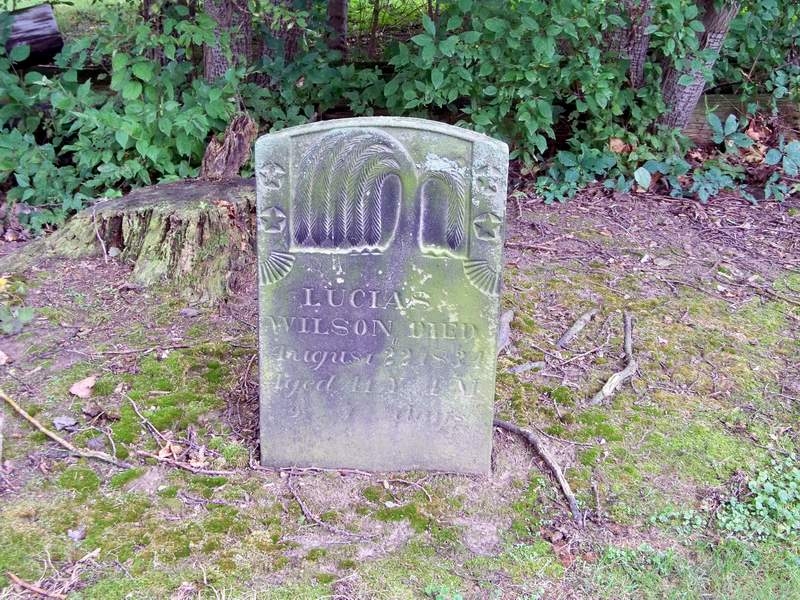 There are few with ornament. This one for Lucias Wilson has four stars, and a stylized weeping willow. In the antebellum XIXth century this was a very popular sign for mourning. There are a few others in this cemetery.
Thursday, September 22, 2011
Cholera Cemetery

 Some years ago, in my very short teaching career, i assigned to the high school science classes a book to read. I did not think much of the education courses i took at university. One point that some classmates brought up was, that, every class should be a reading class. I taught in a very strange school, with a very different pupil population. I would describe it as teaching at the nut house, or having the emotionally disturbed children of financially gifted parents. I was not happy. I saw the children of the bourgeois, and the assumptions of their relatives, and i felt how one could be contemptuous towards them.
Curriculum courses were not helpful. What i needed was abnormal psychology, aberrant psychology. I took one class in educational psychology, that was insufficient. It has been many years, i think one course was abnormal psychology, but it was forensic.
Well these students did not do well with textbooks, so i had them read well written books by scientists. I had one class read, King Solomon's Ring by Konrad Lorenz; one class read, The Panda's Thumb by Stephen Jay Gould; one class read, The Sea Around Us by Rachel Carson; and here is where i got in to trouble, the one class, Rats, Lice, and History by Hans Zinsser. [i made the mistake of lending that book, it had all my notes written on the margins, i have not seen that book in 25 years] Unfortunately, i think i would get in trouble to-day, on account of the increased, and militant stupidity. Carson is anathema to the chemical companies and, therefore Republicans. Gould was a propagandist for evolution, and privately an atheist. They were all good writers, teachers, and scientists; but that is not important to idjits and teabaggers, if anything it is grounds for attack.
Zinsser's book was objected to because of its title. It also dealt with the germ theory of disease. Now, we are living with politically active, and vengeful people who deny science (and history). These people were not on that bandwagon, then. During the course of the XIXth century there were several pandemics of cholera. John Snow studied the locations of death in London, On the Mode of Communication of Cholera. First in 1849, and a second edition in 1855 (with an appendix for the 1854 epidemic). Snow did not believe disease was caused by bad air (miasma). He found it was by bad water. The Broad Street Water Pump was killing people in 1854. It was three feet from a cesspool.
A few years later [1861] Louis Pasteur (and some others) formalised the germ theory of disease. Certain micro-organisms caused disease. Many people did not believe that then [some do not now]. Cholera is caused by the bacterium Vibrio cholerae, which produces a toxin that infects the intestine, which pumps out diarrhoea in such volume, that death occurs within the day.
Cholera, for centuries or millennia, was restricted to Bengal. In the XIXth century it travelled, by land and sea. A ship flying a yellow flag was giving signal cholera was aboard. Port cities were very susceptible. The United States was first visited by cholera in 1832. In 1849 Cincinnati had 8,000 deaths, and many people abandoned the city. Ohio's first State Fair was cancelled. James Polk had just finished his presidency, he died of cholera on 15 June 1849 in Nashville, Tennessee.
Sandusky, Ohio was a port town. They have a cholera cemetery, it is not the only one in Ohio; but in may be the biggest in the country. The cholera was active in Sandusky from 1 July to 7 September 1849. As the state plaque [Erie County loves plaques, there are state markers, county plaques, organisational plaques, and so on; the density based on population is very high] reads, “Of the city's 5667 people in 1849, 3500 fled, and 400 of those remaining were victims of cholera. Most are buried here...The scourge came again in 1850 and 1852...” The numbers on the monument are different, and slightly vaguer.

The cemetery was immediately neglected, and abused variously. In 1924 it was rehabilitated, and a bronze pillar monument erected. The park is just west of the center of town, in a run down neighborhood.
Besides, the state marker, and monument, there are two high birdhouses, several trees and three military stones for Revolutionary War veterans, all with the surname, Ransom. Two are Connecticut veterans [Sandusky was a part of Connecticut's Western Reserve]. Two of them died on 3 November 1840. There are no current stones for anyone else. Yet, other pre-cholera burials took place, including that of a one term Democratic congressman, William Hunter.
Subscribe to:
Posts (Atom)