Wednesday, October 31, 2012

a beckoning skeleton

 Edmund Joseph Sullivan's 1913 illustration

Alike for those who for To-day prepare,
And those that after a To-morrow stare,
A Muezzín from the Tower of Darkness cries
"Fools! your Reward is neither Here nor There!"


—Omar Khayyam (arranged by Edward Fitzgerald) quatrain 24 of 75 in 1st edition – 1859 

 Omar Khayyám *1048, 1131† was a scholar in many fields. His thousand some Persian quatrains have been selectively translated by many over the last century and an half. Perhaps, there is a Persian scholar out there that could give them a proper Köchel number; and another to translate that opus.

Never anticipate tomorrow's sorrow:
Live always in this paradisal Now—
Fated however soon to house, instead,
With others gone these seven thousand years*:
— Robert Graves 1967 from a forged Persian version by a Sufi scholar as quatrain 21 to be equivalent of the above
*age of the world

 poster by Alton Kelly and Stanley Mouse (Stanley George Miller)
This drawing was a partial impetus for the Grateful Dead's garlanded skeleton, Bertha. Now, there is some literature that has earlier presentation of the skulls of Christian martyrs with roses for viewing and veneration. There are many macabre images of skeletons from the time of the black death (post 1347). The Danse Macabre (Dance of Death) was a theme where Death called subjects, both high and low, to dance; for all are united in death.

Tuesday, October 30, 2012

the golden flower of the grave yard

Chrysanthemum (golden flower) path in Barberton, O.

Sunday, i bumped into a friend from Barberton. I had not seen her for a few months. I mentioned, that i enjoyed the Mums Fest. She said, she did not allow herself to ever go. In the old country it was the graveyard flower for All Saints', and All Souls. They would remind her of that.

Yes, it is true. Much, if not all of Catholic Europe, considers it such. They are beautiful flowers, and in bloom there, when so few flowers are. The dead are remembered, and people visit and take care of grave sites. People, and society together in the Church agree about this for the beginning of November. [The Orthodox and Greek Catholics have All Saints the First Sunday after Pentecost.]

Mexico had been a part of Spain. The First of  November is All Saints', the Second is All Souls.  There those two days combined with indigenous folklore, and the resultant became Día de los Muertos (Day of the Dead). The typical flower there is the, somewhat similar, marigold. The colors of yellow, gold, and orange, and the shape of the bloom, and the smell are comparable. Traditionally, people have referred to marigolds of having the smell of death.

Tuesday, September 18, 2012

The government of the people dedicating...

At this moment, on local television there is being broadcast the programme: Death and the Civil War: American Experience. It is another fine programme in the series of this necessary television network. It brings up a point particular to a point being argued in this presidential contest and other political battles, between the party of the Democracy and the one of the plutocracy. Before the War for the Union, the United States of America, and during the war--the Confederacy, had no provision to provide for dead soldiers. It was not considered a government responsibility, but left to individual initiative. The war killed so many men, that, it became so.

Not until the creation of the first national cemetery at Gettysburg did the American government accept responsibility for war dead. Many children memorised the 273 words of Abraham Lincoln's address beginning, "Four score....". The battle was fought July 1, 2 and 3 in 1863. The count of dead bodies on the battlefield was 8,900. The consecration, mentioned by Lincoln, was on November 19.

In front of Cleveland's Board of Education, there is a statue of Abraham Lincoln.
his Gettysburg Address is on a bronze plaque


Four score and seven years ago our fathers brought forth on this continent, a new nation, conceived in Liberty, and dedicated to the proposition that all men are created equal.
Now we are engaged in a great civil war, testing whether that nation, or any nation so conceived and so dedicated, can long endure. We are met on a great battle-field of that war. We have come to dedicate a portion of that field, as a final resting place for those who here gave their lives that that nation might live. It is altogether fitting and proper that we should do this.
But, in a larger sense, we can not dedicate -- we can not consecrate -- we can not hallow -- this ground. The brave men, living and dead, who struggled here, have consecrated it, far above our poor power to add or detract. The world will little note, nor long remember what we say here, but it can never forget what they did here. It is for us the living, rather, to be dedicated here to the unfinished work which they who fought here have thus far so nobly advanced. It is rather for us to be here dedicated to the great task remaining before us -- that from these honored dead we take increased devotion to that cause for which they gave the last full measure of devotion -- that we here highly resolve that these dead shall not have died in vain -- that this nation, under God, shall have a new birth of freedom -- and that government of the people, by the people, for the people, shall not perish from the earth.

Wednesday, September 12, 2012

Earliest Cleveland Deaths

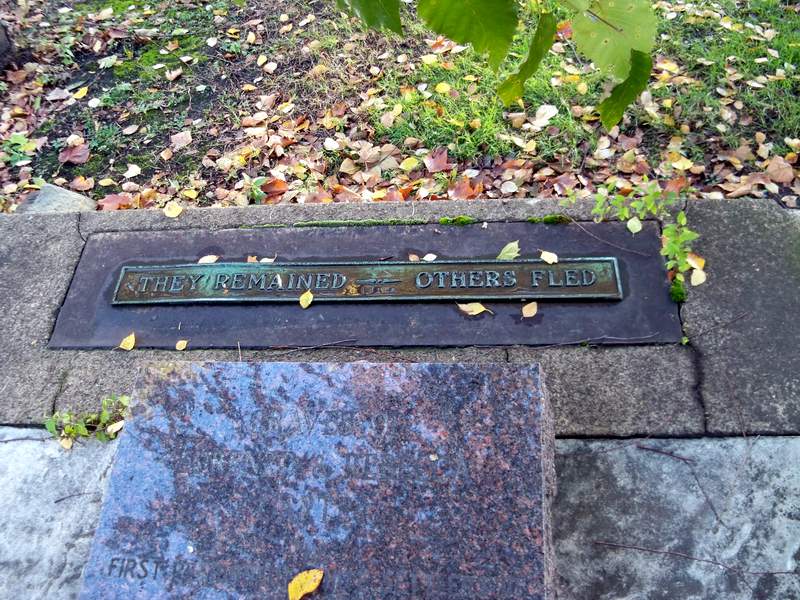
They remained— Others fled
Lorenzo Carter *1767 came to Ohio in 1797. Cleaveland was surveyed the year before. He, and his wife Rebekah, raised a family. His tavern was a trading post on the Cuyahoga, and the only place of meeting. Carter was the chief citizen of Cleaveland. Carter died of cancer in 1814.

The swamp diseases of the river killed, or chased off other settlers. For several years the Carters were the only non-Indians in Cleaveland. Others moved to nearby Doan's Corners (to-day University Circle on the east side), or Newburgh (southeast side).
Cleaveland's first graveyard was, on Ontario Street, south of Public Square. In 1826 bodies were moved to a permanent cemetery on Erie Street (now E. 9th). This 1948 plaque notes 15 of the transferred.

Sunday, September 9, 2012

Jurij

He had his name written in Cyrillic characters in Ukranian, Jurij O. Likholit. Jurij is George. The family name was changed to something similar in spelling. He was born in one country, died in another, and buried in a third.

Saturday, September 8, 2012

Forethought

This fellow had this stone placed while alive, not knowing the century he would die in. If he is still alive, he has passed the century mark. He only wanted else known of his military service.[Riverside]
Fred bought the stone after his wife died. They both belonged to masonic organisations. He is dead now, and he expected to die after 1927, but before 2000. No one has cut the two digits. No family survived him? Apparently no provision was made for the inscription update.[Maple Grove]

Friday, September 7, 2012

Tas kungs ir mans Gans

Tas kungs ir mans Gans = The Lord is my Shepherd

Cleveland Riverside has a Latvian section, and a Belarus section. Cleveland has had a long standing population originating in the nations of eastern Europe.

Latvians are a Baltic people. Most of the Letts came under Swedish rule and Lutheranism in the 17th Century. The stone, supra, has folk designs and a Protestant cross.