Cleveland's Riverside Cemetery (1876) wanted to be the West Side's Lake View. It has some pleasant landscaping, and two beautiful 19th century buildings, and some fine monuments. It has suffered some vandalism, some missing digits on statues.
Part of it was taken for freeways. From the Belarussian section one can look over the highway, and see downtown, and immediately next to the Jennings Freeway is where the Otis Steel Riverside works had been, which Jones-Laughlin bought in 1942, and eventually became a shopping centre.
It is in the most part a lovely park and resting grounds. What i could not stomach was 'Babyland': the graves of children festooned with toys, and enough junk to fill a squadron of Christmas trees. It was gruesome, and kitsch, and sad in a sick way. Don't go down that drive, if you don't have to.
 1896-97 Gatehouse and office, outside walls of Massachusetts brownstone
 This was on a large block monument. In English, this is just a surname; but this a German name, it translates as 'Devil'. When they were handing out names, who really wanted this one? The plant in the 'U' is a thistle, an emblem of the Scots.
 Daykin Lion. I wonder how many kids got a kick out of this one, or were afeared of it? John Daykin was a Yorkshireman, who became a railroader. He was a conductor on Lincoln's funeral train. A canny man, he used his travel to scout for real estate opportunities.
 Leonard Schlather was one of the many beer barons buried in this boneyard. He was brewing in Cleveland before the War for Union. His brewery was once the largest in Cleveland. From brewing he went on to make money in salooning, and banking. He sold out to the Cleveland & Sandusky Brewing (which was a merger of 11 brewers in 1897) in 1902, and which lasted into the 1960s. He †1918, just before Prohibition. His brewery building is now owned by a very successful, former microbrewery. He has the most impressive mausoleum in the park. Here you can see three fine medallions, and stone scroll carving.There are eight brewers (including: Leisy, Gehring, Hoffman, Mueller, Muth) buried in Riverside. Some were born in Germany. It was another German brewer, from Iowa, who the Republicans, and millionaires ran to beat Tom Johnson in 1910. Hermann Baehr stayed for one two year term. He was secretary-treasurer of Cleveland & Sandusky Brewing, a bank executive, a high ranking mason, and a close friend of Mark Hanna (the Karl Rove of his day). He went on to Los Angeles.
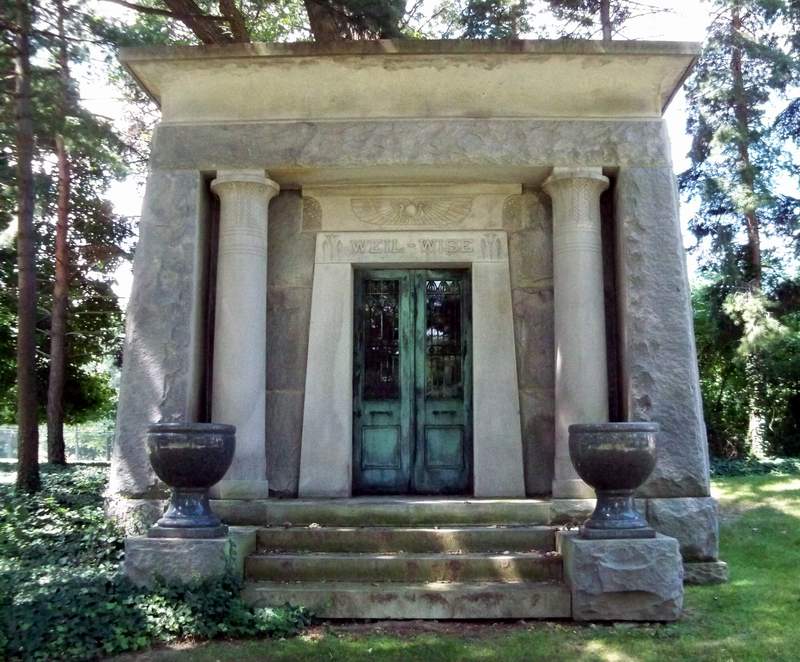 This mausoleum (Mayfield cemetery) resembles an Egyptian temple (mastaba), in its shape, columns, door lintel and jambs, and friezes. On either side of the names, there is a trio of lotus. The lotus (sesen) would open up under the sun, and close under darkness. The pediment above has the vulture wings outspread, with two cobras, and the sun disc. The cobra (uraeus) was believed to spit fire, and was associated with the faro, and the sun. The bronze doors should be cedar. Only sphinxes replacing the vases could make this more Hollywood (or Vegas) perfect.
 At Lake View, here is the same motif, but with more feathers. This winged sun disc of Thebes, as with many Egyptian symbols changed associations over the millenia of use. So whether one insists it is a symbol of Ra or Horus, or someone else—fine. The block pediment is supported by two Egyptian columns.
  Here in a tallish upright stone, with a curved scroll top, is the same motif. On the opposite side are the vulture wings with a scarab (dung beetle). The scarab rolling its ball of shit was analogous to the sun rolling through the sky.
 Some mausoleums have stained glass windows. [supra Lake View, infra Mayfield] These windows take up Egyptian designs. The recurring vulture wings, spears and a head with a cobra crown, all in art deco. The one below, takes the lotus blossoms, and vulture wings to the earlier art nouveau style.


